Pantry pest infestations in Marion County dry storage areas are primarily biological infestations of dry processed grains, pet foods, dried legumes, and spices. In historic homes across Broad Ripple, Woodruff Place,…
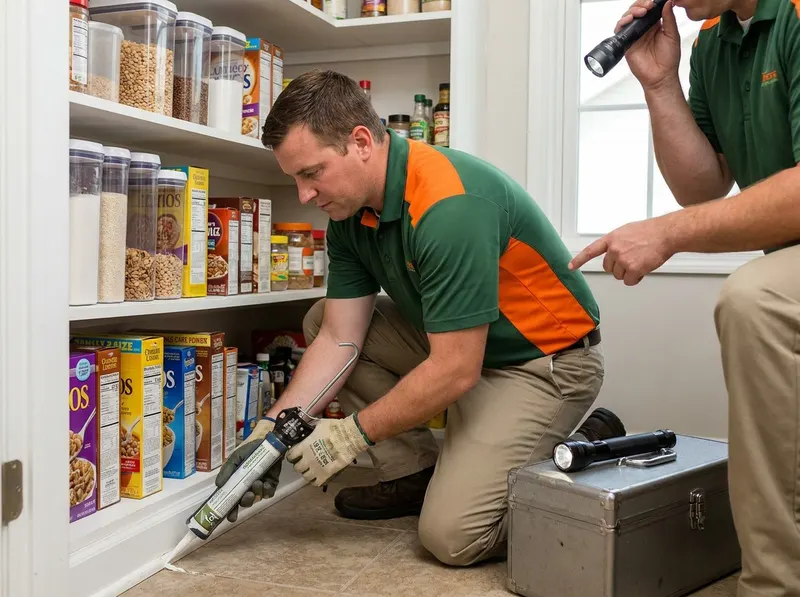
Pantry pest infestations in Marion County dry storage areas are primarily biological infestations of dry processed grains, pet foods, dried legumes, and spices. In historic homes across Broad Ripple, Woodruff Place, and Lockerbie Square, settling foundations and older pine cabinetry create wall-void pathways where adult moths, silken webbing, and beetle pupae migrate outside the primary food cupboard. Stored product pest control differs from generalized insect spraying: broadcast insecticides are unsafe and ineffective around exposed human and pet food containers. True exclusion relies on systematic food segregation, mechanical extraction of larvae from shelf peg holes, non-residual contact treatments, and siliconized acrylic void sealing along cabinet joints.
Decision-fit guidance depends on the current stage of insect dispersal. If a homeowner discovers adult Indian meal moths flying in living areas or larvae crawling upward toward ceiling crowns in Butler-Tarkington or Meridian-Kessler, aerosol fogging is inappropriate because it contaminates cooking surfaces without stopping the larval breeding source. A dedicated exclusion service fits when larvae penetrate boxed grains or pantry margins; an over-the-counter pheromone trap fits only for monitoring flying adults, as it captures exclusively male moths and cannot arrest active larval eating. The trade-off of thorough mechanical exclusion is the necessary disposal of unsealed, compromised grain packaging to guarantee total life-cycle interruption.
The operational procedure follows a systematic three-step progression. Step 1 involves an itemized examination of all paper, cardboard, and thin-film plastic packaging to identify webbing, fecal frass, and live larvae, followed by immediate containment in 4-mil disposal liners. Step 2 applies targeted, high-efficiency particulate air (HEPA) vacuum extraction into hinge pockets, shelf pegs, and sub-cabinet voids to remove hidden pupae. Step 3 seals perimeter drywall gaps, baseboards, and cabinet junctions using food-safe caulking before deploying species-specific non-toxic pheromone monitors. Service vehicles access residential properties from Speedway and Irvington to Fletcher Place and Castleton.
Every job gets a firm, written price after a free on-site visit.
Tell us about your stored product pantry pest exclusion job in Indianapolis and we'll send a clear, written quote, usually the same day.
 Rovika Insect Services