Residential foundations across Marion County face distinct subterranean moisture dynamics that drive ground-dwelling arthropods indoors. In historic neighborhoods like Woodruff Place, Irvington, and Lockerbie Square,…
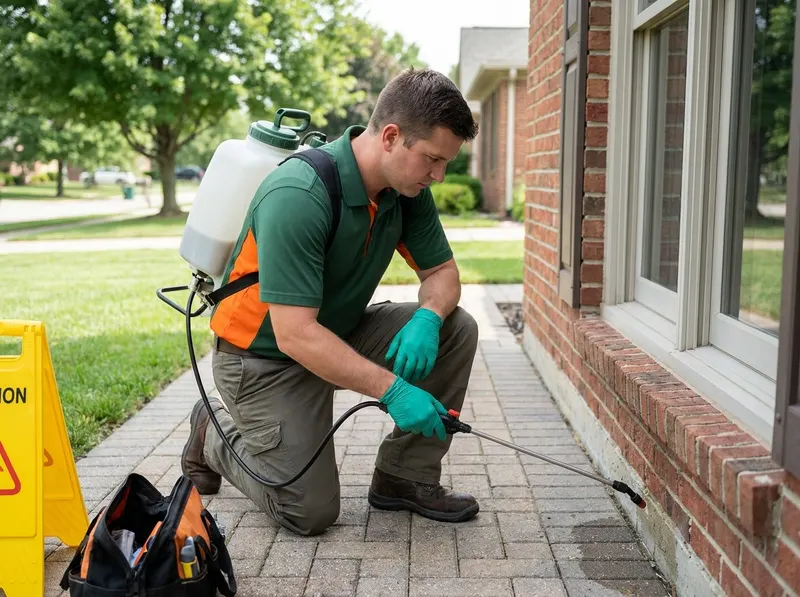
Residential foundations across Marion County face distinct subterranean moisture dynamics that drive ground-dwelling arthropods indoors. In historic neighborhoods like Woodruff Place, Irvington, and Lockerbie Square, aged brick footings and porous mortar beds settle over time, creating micro-fissures along the soil grade. In modern slabs across Castleton and Speedway, perimeter expansion joints and plumbing sub-sleeves provide open entry points. When nocturnal insect activity disrupts household rest between midnight and dawn, barrier science stops biological transit without saturating interior living zones in indiscriminate broad-spectrum sprays. Micro-perimeter barrier engineering binds botanical-derived or synthetic pyrethroid residues to exterior concrete, limestone, and wood sill plates, forming an impenetrable band that dehydrates and neutralizes crawling pests on contact.
A single targeted perimeter remediation functions differently than a whole-home fumigation or broad granular dispersal. Surface-applied micro-encapsulated polymers adhere directly to foundation walls three feet vertically above soil and three feet outward along mulch or turf perimeters. For crawlspace homes in Meridian-Kessler and Broad Ripple, technicians directly inject targeted drying agents into structural weep holes and sill interfaces. Interior treatments are restricted to low-impact crevice injections along kitchen plumbing voids, basement floor-wall seams, and utility entryways. This approach isolates chemical residues away from infants, pregnant occupants, and indoor pets while drying clear within 60 to 90 minutes.
Decision guidance depends on structure construction and infestation depth: if crawling pests are isolated along exterior baseboards, basement walls, or garage perimeters, an exterior micro-barrier remediation resolves the problem in a single visit without continuous recurring fees; if active nesting exists inside hollow wall cavities or insulated subfloors, targeted micro-injection and secondary localized baits are required alongside the perimeter shell. The technical trade-off involves application longevity versus soil composition: limestone dust, dense clay, and heavy roofline drip edges in Fletcher Place or Butler-Tarkington degrade light water-based sprays faster, requiring micro-encapsulated formulations that withstand seasonal humidity and high rainfall.
Every job gets a firm, written price after a free on-site visit.
Tell us about your crawling insect and micro-perimeter barriers job in Indianapolis and we'll send a clear, written quote, usually the same day.
 Rovika Insect Services